One standard for how your engineers work with AI.
Every developer sets up Claude, Copilot, and Cursor their own way, and no one can see the sprawl. baselane turns it into a single versioned standard — a git-native, open-source harness.json and pack engine — ships it to every repo and laptop, and shows you exactly who's on it.
Five hundred engineers, five hundred ways of working.
AI showed up one laptop at a time. Everyone picked their own tools and wrote their own rules. Nothing matches, and nobody has visibility into any of it.
Working well with AI is a standards problem.
A smarter model doesn't fix this. What fixes it is agreeing on how your team works with AI, then keeping every repo and laptop on that agreement as it changes. That's what baselane does.
Audit, standardize, distribute, govern.
Four steps, each producing something concrete the next one builds on.
Audit
Point baselane at a repo. It reads the stack and names the pack that fits.
langs: ts, tsx
tests: vitest ✓
→ software-engineer
Standardize
Pick a pack, or shape your own. One source renders config for every AI tool.
CLAUDE.md
.claude/agents/
copilot-instructions.md
GEMINI.md
Distribute
Open a pull request in every repo. The desktop app carries it to laptops, leaving local work alone.
✓ PR #128 → acme/web
✓ PR #129 → acme/api
Govern
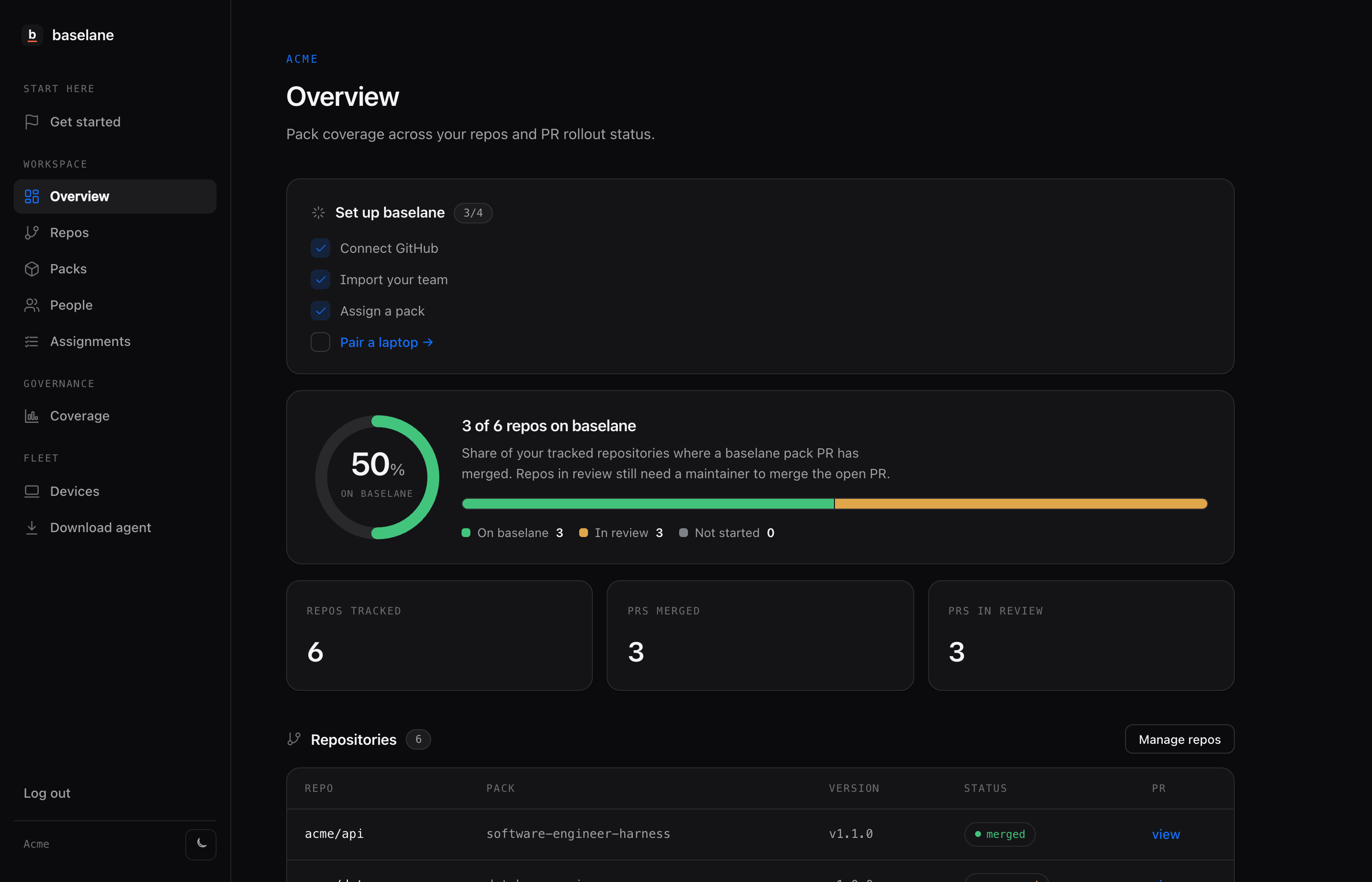
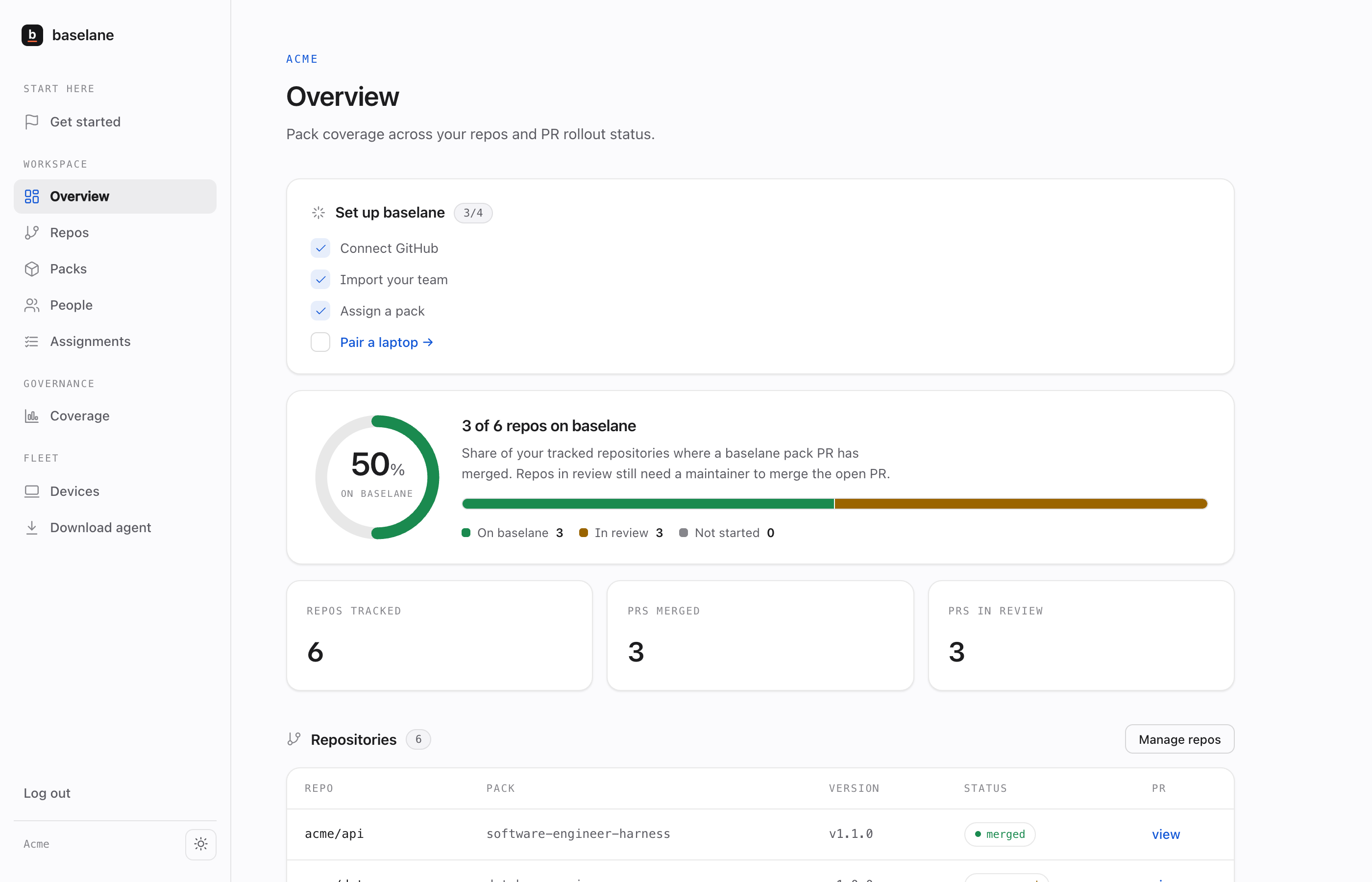
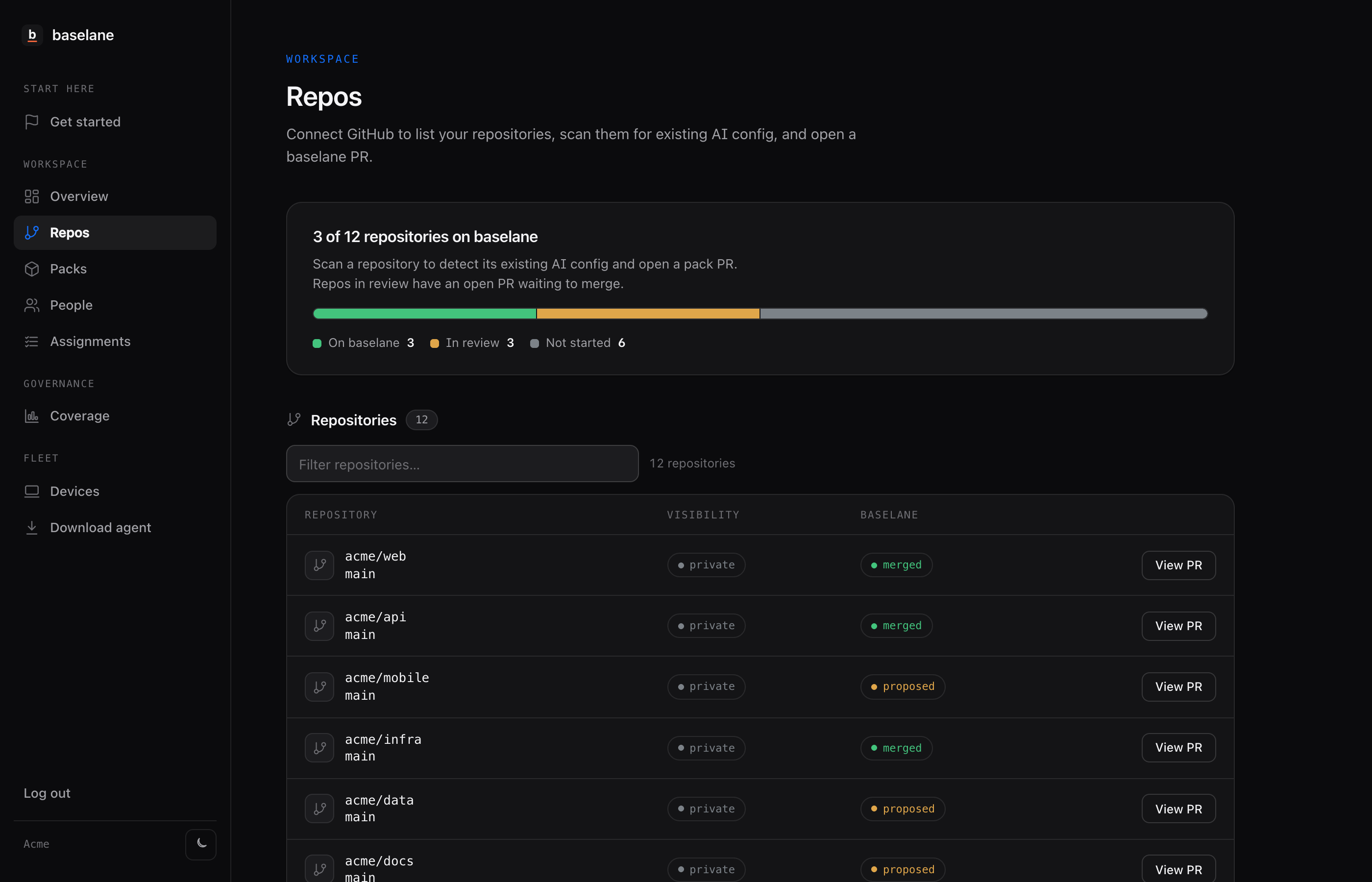
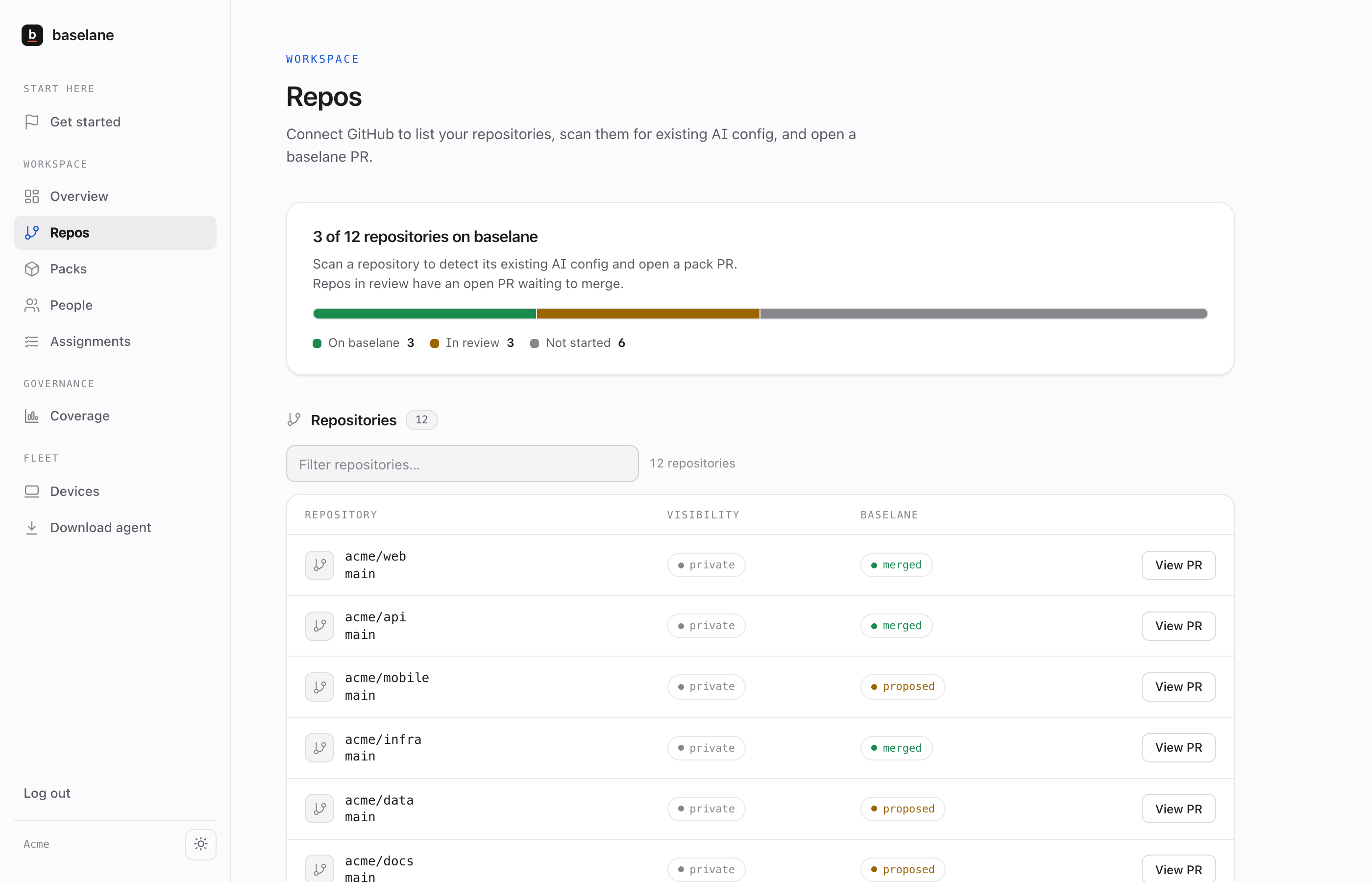
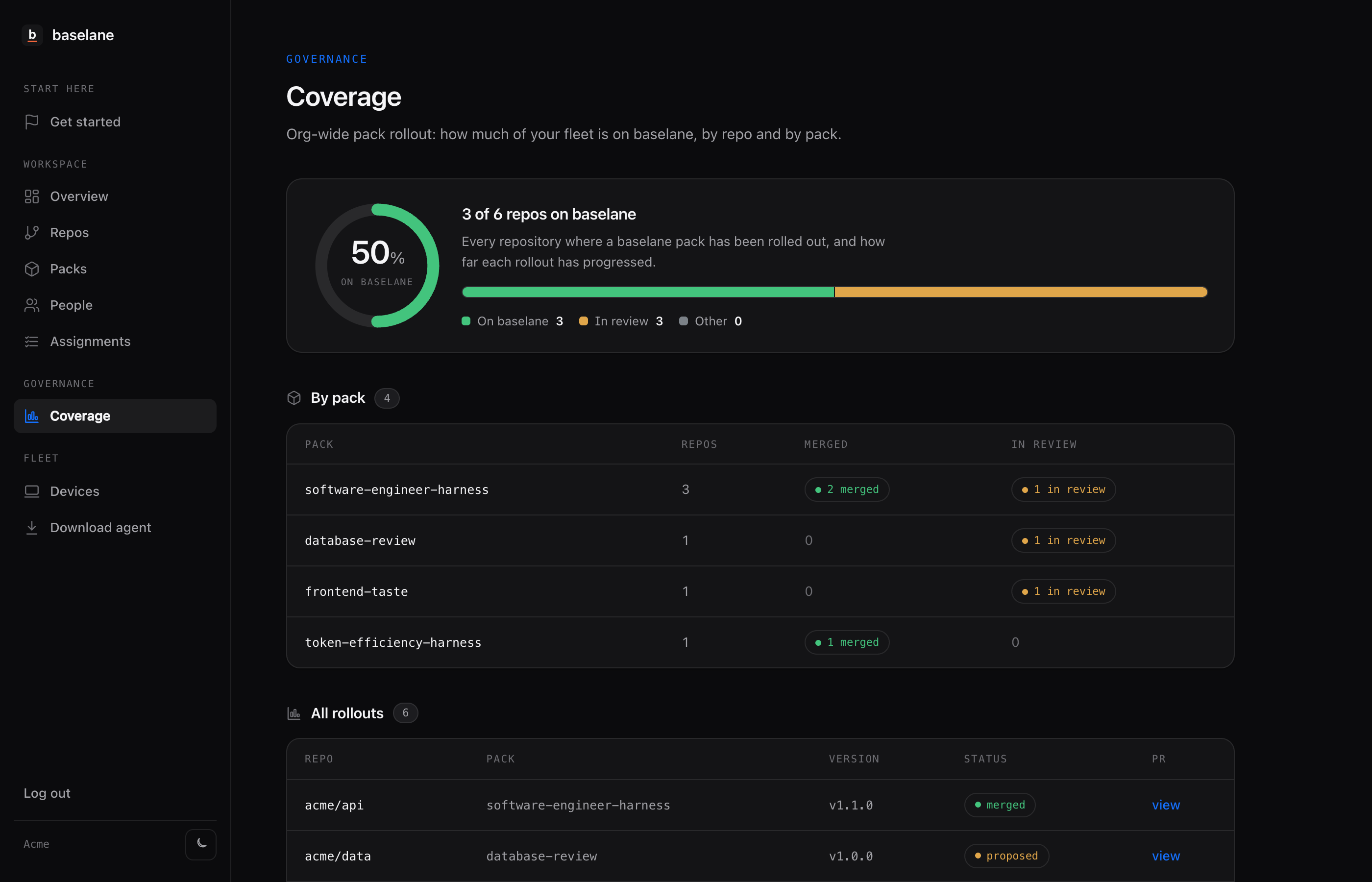
See which repo and which laptop is on baselane, at which version, right now.
maya on baselane
acme/infra not yet
Know exactly who's on baselane.
A live count of how much of your codebase, and how many of your engineers' laptops, run the standard you set. Down to the repo, down to the person.
Your standard, versioned like code.
A pack is your team's way of working with AI, written down: the agents it runs, the commands it exposes, the rules it holds people to. Versioned, reviewed, and rendered for every tool. Start from a curated one, drag your own together in the visual builder, or describe what you want and refine the AI's validated draft — nothing saves until you approve it.
Software-engineer harness
The disciplined default: plan, build, then an independent review. TDD, scoped sessions, and guardrails that keep changes surgical.
Token-efficiency harness
Cuts AI spend without cutting output: session hygiene, model tiering, thinking caps, and a budget on every autonomous run.
Builder / checker loop
Two roles, one rule: an independent checker re-runs the tests itself before any change counts as done.
A pack carries more than config.
Config is instructions, rendered once. A harness is state that accumulates over the life of a repo: memory, a task ledger, a wiki, a design system, a codegraph, held by the pack and kept current as things change. Turn on what you need; each capability names its own method, and one that isn't built yet says so instead of pretending. Compose it all in a visual drag-and-drop builder, or describe what you want and let the AI assistant draft the pack for you.
Facts that survive the session
/remember writes a durable entry; session start reads the relevant ones back in. Org-shared memory syncs to every laptop through the agent; repo-local memory ships in the PR.
One DESIGN.md, on-brand everywhere
Theme, palette, type, components, do's and don'ts: the nine-section spec AI tools already read, so generated UI matches your brand instead of a generic template.
A ledger that outlives the run
Plans and progress recorded as they happen, so a session that gets interrupted, or a different engineer entirely, can pick up exactly where it stopped.
Read before, write after
Agents check the wiki before touching a file and update it after. Most knowledge tools only read; this one writes back, so it doesn't go stale.
A map, not a guess
A queryable map of how the codebase actually connects, so agents stop re-deriving structure they could just look up.
Your setup, on every machine you touch.
- open sourceApache-2.0, on GitHub. The CLI, pack engine, and renderers are open source — no account, no server, git-native.
- one sourceEvery tool from one file. Claude, Cursor, Copilot, and Gemini configs render from the same pack. No more hand-syncing five files.
- the CLIInstall, track, refresh. baselane install github:owner/repo@v1 pins exact content. baselane drift shows what changed. baselane update refreshes it.
- the appComing soon. A small desktop app will pair your laptop to the org portal and keep it on the current standard, without overwriting the tweaks you've made yourself.
Put your whole org on baselane.
Start with the open-source CLI today — npm i -g baselane — then sign up to put the whole org on it.
You’re on the list. We’ll reach out. Or email us.